Device-Independent Oblivious Transfer
This example protocol achieves the task of device-independent oblivious transfer in the bounded quantum storage model using a computational assumption.
Assumptions
- The quantum storage of the receiver is bounded during the execution of the protocol
- The device used is computationally bounded - it cannot solve the Learning with Errors (LWE) problem during the execution of the protocol
- The device behaves in an IID manner - it behaves independently and identically during each round of the protocol
Outline
Notation
Protocol Description
Protocol 1: DI Rand 1-2 OT

- Data generation:
- The sender and receiver execute rounds of Protocol 2 (Self-testing) with the sender as Alice and receiver as Bob, and with the following modification:
- If , then with probability , the receiver does not use the measurement basis question supplied by the sender and instead inputs Computational, Hadamard where Failed to parse (Conversion error. Server ("https://wikimedia.org/api/rest_") reported: "Cannot get mml. Server problem."): {\displaystyle c} is the receiver's choice bit. Let be the set of indices marking the rounds where this has been done.
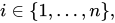
- For each round Failed to parse (Conversion error. Server ("https://wikimedia.org/api/rest_") reported: "Cannot get mml. Server problem."): {\displaystyle i\in \{1,...,n\}}
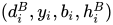
, the receiver stores:
- if
- or if
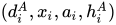
- The sender stores and if or and if
- For every the sender stores the variable (round type), defined as follows:
- if and Hadamard, then Bell
- else, set Product
- For every the sender chooses , indicating a test round or generation round, as follows:
- if Bell, choose {Test, Generate} uniformly at random
- else, set Test
- The sender sends ( ) to the receiver
- Testing:
- The receiver sends the set of indices to the sender. The receiver publishes their output for all Test rounds where . Using this published data, the sender determines the bits which an honest device would have returned.
- The sender computes the fraction of test rounds (for which the receiver has published data for) that failed. If this exceeds some , the protocol aborts
- Preparing data:
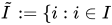
- Let and Generate} and . The sender checks if there exists a such that . If such a exists, the sender publishes and, for each , the trapdoor corresponding to the key Failed to parse (Conversion error. Server ("https://wikimedia.org/api/rest_") reported: "Cannot get mml. Server problem."): {\displaystyle k_{i}^{B}} (given by the sender in the execution of Protocol 2,Step 1); otherwise the protocol aborts.
- For each the sender calculates Failed to parse (Conversion error. Server ("https://wikimedia.org/api/rest_") reported: "Cannot get mml. Server problem."): {\displaystyle v_{i}^{\alpha }}
and defines by
- Failed to parse (Conversion error. Server ("https://wikimedia.org/api/rest_") reported: "Cannot get mml. Server problem."): {\displaystyle w_{i}^{\alpha }={\begin{cases}v_{i}^{\alpha },{\mbox{if }}x_{i}={\mbox{Hadamard}}\\0,{\mbox{if }}x_{i}={\mbox{Computational}}\end{cases}}}
- and the receiver calculates Failed to parse (Conversion error. Server ("https://wikimedia.org/api/rest_") reported: "Cannot get mml. Server problem."): {\displaystyle v_{i}^{\beta }} and defines by
- Obtaining output:
- The sender randomly picks two hash functions Failed to parse (Conversion error. Server ("https://wikimedia.org/api/rest_") reported: "Cannot get mml. Server problem."): {\displaystyle f_{0},f_{1}\in F} , announces and for each , and outputs Failed to parse (Conversion error. Server ("https://wikimedia.org/api/rest_") reported: "Cannot get mml. Server problem."): {\displaystyle s_{0}=f_{0}(a\oplus w^{\alpha }|_{{\tilde {I}}_{0}})} and , where Computational,HadamardFailed to parse (Conversion error. Server ("https://wikimedia.org/api/rest_") reported: "Cannot get mml. Server problem."): {\displaystyle ]_{r}\}}
- Receiver outputs


![{\displaystyle ]_{c}}](https://wikimedia.org/api/rest_v1/media/math/render/svg/a1834196203f4b90ce41f28fec233ba3185eb032)


















Protocol 2: Self-testing with a single verifier
- Alice chooses the state bases {Computational,Hadamard} uniformly at random and generates key-trapdoor pairs Failed to parse (Conversion error. Server ("https://wikimedia.org/api/rest_") reported: "Cannot get mml. Server problem."): {\displaystyle (k^{A},t^{A}),(k^{B},t^{B})} , where the generation procedure for Failed to parse (Conversion error. Server ("https://wikimedia.org/api/rest_") reported: "Cannot get mml. Server problem."): {\displaystyle k^{A}} and depends on Failed to parse (Conversion error. Server ("https://wikimedia.org/api/rest_") reported: "Cannot get mml. Server problem."): {\displaystyle \theta ^{A}} and a security parameter , and likewise for Failed to parse (Conversion error. Server ("https://wikimedia.org/api/rest_") reported: "Cannot get mml. Server problem."): {\displaystyle k^{B}} and . Alice supplies Bob with . Alice and Bob then respectively send to the device.
- Alice and Bob receive strings and Failed to parse (Conversion error. Server ("https://wikimedia.org/api/rest_") reported: "Cannot get mml. Server problem."): {\displaystyle c^{B}} , respectively, from the device.
- Alice chooses a challenge type Failed to parse (Conversion error. Server ("https://wikimedia.org/api/rest_") reported: "Cannot get mml. Server problem."): {\displaystyle CT\in \{a,b\}} , uniformly at random and sends it to Bob. Alice and Bob then send Failed to parse (Conversion error. Server ("https://wikimedia.org/api/rest_") reported: "Cannot get mml. Server problem."): {\displaystyle CT} to each component of their device.
- If Failed to parse (Conversion error. Server ("https://wikimedia.org/api/rest_") reported: "Cannot get mml. Server problem."): {\displaystyle CT=a}
:
- Alice and Bob receive strings and , respectively, from the device.
- If :
- Alice and Bob receive strings Failed to parse (Conversion error. Server ("https://wikimedia.org/api/rest_") reported: "Cannot get mml. Server problem."): {\displaystyle d^{A}} and Failed to parse (Conversion error. Server ("https://wikimedia.org/api/rest_") reported: "Cannot get mml. Server problem."): {\displaystyle d^{B}} , respectively, from the device.
- Alice chooses uniformly random measurement bases (questions) {Computational,Hadamard} and sends to Bob. Alice and Bob then, respectively, send and Failed to parse (SVG (MathML can be enabled via browser plugin): Invalid response ("Math extension cannot connect to Restbase.") from server "https://wikimedia.org/api/rest_v1/":): {\displaystyle y} to the device.
- Alice and Bob receive answer bits Failed to parse (SVG (MathML can be enabled via browser plugin): Invalid response ("Math extension cannot connect to Restbase.") from server "https://wikimedia.org/api/rest_v1/":): {\displaystyle a} and Failed to parse (SVG (MathML can be enabled via browser plugin): Invalid response ("Math extension cannot connect to Restbase.") from server "https://wikimedia.org/api/rest_v1/":): {\displaystyle b} , respectively, from the device. Alice and Bob also receive bits Failed to parse (SVG (MathML can be enabled via browser plugin): Invalid response ("Math extension cannot connect to Restbase.") from server "https://wikimedia.org/api/rest_v1/":): {\displaystyle h^A} and Failed to parse (SVG (MathML can be enabled via browser plugin): Invalid response ("Math extension cannot connect to Restbase.") from server "https://wikimedia.org/api/rest_v1/":): {\displaystyle h^B} , respectively, from the device.


Properties
Further Information
References
*contributed by Chirag Wadhwa