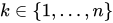
Anonymous Conference Key Agreement using GHZ states

From Quantum Protocol Zoo
Revision as of 20:59, 7 January 2022 by Chirag (talk | contribs)
Jump to navigation Jump to search


This example protocol achieves the functionality of quantum conference key agreement. This protocol allows multiple parties in a quantum network to establish a shared secret key anonymously.


Assumptions

We require the following for this protocol:

  1. A source of n-party GHZ states
  2. Private randomness sources
  3. A randomness source that is not associated with any party
  4. A classical broadcasting channel
  5. Pairwise private communication channels

Outline

  • First, the sender notifies each receiver in the network anonymously
  • The entanglement source generates and distributes sufficient GHZ states to all nodes in the network
  • The GHZ states are distilled to establish multipartite entanglement shared only by the participating parties (the sender and receivers)
  • Each GHZ state is randomly chosen to be used for either Verification or Key Generation. For Key Generation rounds, a single bit of the key is established using one GHZ state by measuring in the Z-basis
  • If the sender is content with the Verification results, they can anonymously validate the protocol and conclude that the key has been established successfully.

Notation

Protocol Description

Protocol 1: Anonymous Verifiable Conference Key Agreement

Input: Parameters Failed to parse (SVG (MathML can be enabled via browser plugin): Invalid response ("Math extension cannot connect to Restbase.") from server "https://wikimedia.org/api/rest_v1/":): {\displaystyle L} and Failed to parse (SVG (MathML can be enabled via browser plugin): Invalid response ("Math extension cannot connect to Restbase.") from server "https://wikimedia.org/api/rest_v1/":): {\displaystyle D}

Requirements: A source of n-party GHZ states; private randomness sources; a randomness source that is not associated with any party; a classical broadcasting channel; pairwise private communication channels

Goal: Anonymoous generation of key between sender and receivers

  1. The sender notifies the receivers by running the Notification protocol
  2. The source generates and shares GHZ states
  3. The parties run the Anonymous Multipartite Entanglement protocol on the GHZ states
  4. For each Failed to parse (SVG (MathML can be enabled via browser plugin): Invalid response ("Math extension cannot connect to Restbase.") from server "https://wikimedia.org/api/rest_v1/":): {\displaystyle (m+1)} -partite GHZ state, the parties do the following:
    • They ask a source of randomness to broadcast a bit Failed to parse (Conversion error. Server ("https://wikimedia.org/api/rest_") reported: "Cannot get mml. Server problem."): {\displaystyle b} such that PrFailed to parse (Conversion error. Server ("https://wikimedia.org/api/rest_") reported: "Cannot get mml. Server problem."): {\displaystyle [b=1]={\frac {1}{D}}}
    • Verification round: If b = 0, the sender runs Verification as verifier on the state corresponding to that round, while only considering the announcements of the receivers. The remaining parties announce random values.
    • KeyGen round: If b = 1, the sender and receivers measure in the Z-basis.
  5. If the sender is content with the checks of the Verification protocol, they can anonymously validate the protocol

Protocol 2: Notification

Input: Sender's choice of receivers

Goal: The receivers get notified

Requirements: Private pairwise classical communication channels and randomness sources

For agent :

  1. All agents do the following:
    • When agent is the sender: If is not a receiver, the sender chooses random bits Failed to parse (Conversion error. Server ("https://wikimedia.org/api/rest_") reported: "Cannot get mml. Server problem."): {\displaystyle \{r_{j,k}^{i}\}_{k=1}^{n}} such that Failed to parse (Conversion error. Server ("https://wikimedia.org/api/rest_") reported: "Cannot get mml. Server problem."): {\displaystyle \bigoplus _{k=1}^{n}r_{j,k}^{i}=0} . Otherwise, if is a receiver, the sender chooses random bits such that Failed to parse (Conversion error. Server ("https://wikimedia.org/api/rest_") reported: "Cannot get mml. Server problem."): {\displaystyle \bigoplus _{k=1}^{n}r_{j,k}^{i}=1} . The sender sends bit Failed to parse (Conversion error. Server ("https://wikimedia.org/api/rest_") reported: "Cannot get mml. Server problem."): {\displaystyle r_{j,k}^{i}} to agent
    • When agent is not the sender: The agent chooses random bits Failed to parse (Conversion error. Server ("https://wikimedia.org/api/rest_") reported: "Cannot get mml. Server problem."): {\displaystyle \{r_{j,k}^{i}\}_{k=1}^{n}} such that Failed to parse (Conversion error. Server ("https://wikimedia.org/api/rest_") reported: "Cannot get mml. Server problem."): {\displaystyle \bigoplus _{k=1}^{n}r_{j,k}^{i}=0} and sends bit Failed to parse (Conversion error. Server ("https://wikimedia.org/api/rest_") reported: "Cannot get mml. Server problem."): {\displaystyle r_{j,k}^{i}} to agent
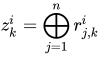
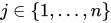
  2. All agents receive Failed to parse (Conversion error. Server ("https://wikimedia.org/api/rest_") reported: "Cannot get mml. Server problem."): {\displaystyle \{r_{j,k}^{i}\}_{j=1}^{n}} , and compute Failed to parse (Conversion error. Server ("https://wikimedia.org/api/rest_") reported: "Cannot get mml. Server problem."): {\displaystyle z_{k}^{i}=\bigoplus _{j=1}^{n}r_{j,k}^{i}} and send it to agent
  3. Agent takes the received Failed to parse (Conversion error. Server ("https://wikimedia.org/api/rest_") reported: "Cannot get mml. Server problem."): {\displaystyle \{z_{k}^{i}\}_{k=1}^{n}} to compute Failed to parse (Conversion error. Server ("https://wikimedia.org/api/rest_") reported: "Cannot get mml. Server problem."): {\displaystyle z^{i}=\bigoplus _{k=1}^{n}z_{k}^{i}} . If Failed to parse (Conversion error. Server ("https://wikimedia.org/api/rest_") reported: "Cannot get mml. Server problem."): {\displaystyle z^{i}=1} , they are thereby notified to be a designated receiver.
Protocol 3: Anonymous Multiparty Entanglement

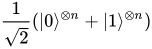
Input: -partite GHZ state Failed to parse (SVG (MathML can be enabled via browser plugin): Invalid response ("Math extension cannot connect to Restbase.") from server "https://wikimedia.org/api/rest_v1/":): {\displaystyle \frac{1}{\sqrt{2}}(|0\rangle^{\otimes n} + |1\rangle^{\otimes n})}
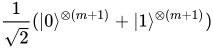
Output: Failed to parse (Conversion error. Server ("https://wikimedia.org/api/rest_") reported: "Cannot get mml. Server problem."): {\displaystyle (m+1)} -partite GHZ state Failed to parse (Conversion error. Server ("https://wikimedia.org/api/rest_") reported: "Cannot get mml. Server problem."): {\displaystyle {\frac {1}{\sqrt {2}}}(|0\rangle ^{\otimes (m+1)}+|1\rangle ^{\otimes (m+1)})} shared between the sender and receivers
Requirements: A broadcast channel; private randomness sources

  1. Sender and receivers draw a random bit each. Everyone else measures their qubits in the X-basis, yielding a measurement outcome bit
  2. All parties broadcast their bits in a random order, or if possible, simultaneously.
  3. The sender applies a Z gate to their qubit if the parity of the non-participating parties' bits is odd.

Protocol 4: Verification

Input: A verifier V; a shared state between parties

Goal: Verification or rejection of the shared state as the GHZFailed to parse (Conversion error. Server ("https://wikimedia.org/api/rest_") reported: "Cannot get mml. Server problem."): {\displaystyle _{k}} state by V

Requirements: Private randomness sources; a classical broadcasting channel

  1. Everyone but V draws a random bit Failed to parse (Conversion error. Server ("https://wikimedia.org/api/rest_") reported: "Cannot get mml. Server problem."): {\displaystyle b_{i}} and measures in the X or Y basis if their bit equals 0 or 1 respectively, obtaining a measurement outcome . V chooses both bits at random
  2. Everyone (including V) broadcasts Failed to parse (Conversion error. Server ("https://wikimedia.org/api/rest_") reported: "Cannot get mml. Server problem."): {\displaystyle (b_{i},m_{i})}
  3. V resets her bit such that Failed to parse (Conversion error. Server ("https://wikimedia.org/api/rest_") reported: "Cannot get mml. Server problem."): {\displaystyle \sum _{i}b_{i}=0(} mod Failed to parse (Conversion error. Server ("https://wikimedia.org/api/rest_") reported: "Cannot get mml. Server problem."): {\displaystyle 2)} . She measures in the X or Y basis if her bit equals 0 or 1 respectively, thereby also resetting her Failed to parse (SVG (MathML can be enabled via browser plugin): Invalid response ("Math extension cannot connect to Restbase.") from server "https://wikimedia.org/api/rest_v1/":): {\displaystyle m_i = m_v}
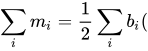
  4. V accepts the state if and only if Failed to parse (SVG (MathML can be enabled via browser plugin): Invalid response ("Math extension cannot connect to Restbase.") from server "https://wikimedia.org/api/rest_v1/":): {\displaystyle \sum_im_i = \frac{1}{2}\sum_ib_i (} mod Failed to parse (SVG (MathML can be enabled via browser plugin): Invalid response ("Math extension cannot connect to Restbase.") from server "https://wikimedia.org/api/rest_v1/":): {\displaystyle 2)}

Properties

Further Information

References